Drop by the Steampunk Cookery website.
Showing posts with label original. Show all posts

Sunday, March 11, 2012

Field Expedient Mac and Cheese

Sometimes, you get out of work at 1 AM after closing down a kitchen for an hour, and you're hungry. Sometimes, you manage to stop at a fast food joint or a coney island (a Michigan-native variety of the 24-hour diner, specializing in chili dogs with onions and mustard, and Chicken Lemon Rice soup.) Sometimes, you grab a pack of snack crackers at a gas station and feed yourself on $3, including a pop or sports drink.

Sometimes, you get home at 1:30 AM and you're just damn hungry. So you pull out a slice of havarti cheese from the fridge, and grab a log of Norcino salami, cured and covered in white mold. You slice yourself a bit, and nibble a corner of cheese, and think to yourself, "I want macaroni and cheese, but I don't have any to microwave and I don't have a box of blue stuff."

Now, don't get me wrong. I love Blue Box Macaroni and Cheese. I grew up very close to my grandmother, and while she didn't produce many culinary delights for me, she did make me Kraft Mac & Cheese, which was bright orange and delicious to my young self. At those times in my life when I've been at my lowest, or most in need of comfort, I've gone and bought boxes of Kraft M&C just so I could remember my Nana, and feel better about my life.

That, however, is somewhat of a diversion from the main focus here—field expedient mac and cheese, which is what happens when a hungry cook gets home from work and wants a dinner.

Mornay sauce is, traditionally, béchamel sauce with Gruyère and Parmesan cheeses added; In this instance, I've produced a slight variation on that, with Havarti, cheddar, and Parmesan, as well as a bit of parsley.

Monday, February 27, 2012

15-Hour Red Wine Brisket

Beef en Filo with Onion-Leek Marmalade and Chive Garnish.
Sometimes, one cooks with almost no time. In a restaurant, for example, the goal is to reduce any given item to about 10 or 15 minutes total of preparation from "hey, we need a ______" to it going out to the diner. This means that some things are partly finished in advance, destined for a sort of reheating (for example, pasta is often cooked just short of al dente, then re-boiled to finish cooking at service.) Other times, you have a couple hours, like cooking a family dinner. Finally, one can periodically cook with all the time in the world—that is the sort of situation that spawned this dish.

This began rather harmlessly as a variant on the Red Wine Braised Short Ribs that I've made before; in this case, I didn't marinate the beef, nor did I include a lot of aromatic herbs with the braising liquid. Instead, I opted for a somewhat simple, rather old-fashioned approach. I simply placed all the ingredients in a large pan, covered it, and braised it in the oven until it was tender.

Thursday, December 15, 2011

Roasted Acorn Squash Soup

Acorn Squash.
Photo from Wikimedia Commons.
In November I cooked for a great number of people; one group lucky enough to eat my food (if I may, somewhat egotistically, describe the experience thus,) was the Indian Village Women's Garden Club. Indian Village is an area of Detroit containing some of the oldest standing houses in the area, most of them what could be described as mansions—especially in the Victorian era, when many of them were built—and most of those still complete with butlers' pantries, kitchens wholly closed-off from the rest of the house, secret passages, back staircases, servants' quarters, and so on: the whole package of Victorian Opulence.

I was asked to prepare a meal for the ladies, and speak about the historical cooking techniques, theories, and styles that I have documented here. I took the chance to refine the speech I would ultimately give at Teslacon, as well as to debut the curry recipe I intended to cook at the con. I also wanted to take the opportunity to write some new recipes and try some new techniques for preparing them, which is represented in this recipe.

Thursday, December 8, 2011

Chicken Curry - From Leftovers

Photograph by Mark Staubitz, at Teslacon II
(The blue pot soon to hold chicken curry.)
Mrs. Beeton and many of her contemporary cookbook writers were very concerned with using leftover food. In an age lacking refrigeration or the ability to freeze leftover food, the remedy was to create recipes to use that cooked meat, like Chicken Croquettes, meat pies, and stews of cooked meat. These recipes highlight one of the main drives of cooking in the Victorian era, a desire—and indeed a need—for food utilization. Sausages, terrines, and pâtés all see their beginnings in this need to utilize all the parts of a meat animal, and recipes like the one below (and a hundred different variations on hashed meat) come from a need to make something of the very valuable food items left after a meal.

Friday, September 16, 2011

A Triumphant Return

Or sort of, anyhow. The restaurant and I have amicably parted ways—I wasn't exactly what they needed, and they weren't exactly what I needed, and that was (as they say) that. They're some very nice businesspeople and I would work for them again in the future, if the opportunity presented itself.

Once again, that leaves me here to contemplate life, the universe, and everything—and to cook delicious food and present it to the lot of you!

Last week, I returned to the Phoenix Café, with two dishes for the assembled masses: From New Vegetarian Dishes by Mrs. Bowdich, 1892, a preparation of Green Beans (which I purchased fresh at that week's Tuesday Market at Eastern Market,) and Chicken Cacciatore.

Green Beans 
1 shallot, minced
1 pint (473 ml) tomato juice
1 pound (453 g) green beans, steamed and shocked
1/2 teaspoon (2.5 ml) salt
1/4 teaspoon (1.25 ml) pepper
a blonde roux of 1 oz (28 g) flour and 1 oz (28 g) olive oil
 

1. Sweat the shallot, and add the tomato juice. Whisk in the roux, Bring to a boil, reduce the heat and simmer about half an hour.

2. Season with pepper and salt. Add the Green beans in, and thoroughly re-heat.

(When I prepared this, I used tomato purée instead of juice, and a bit of garlic instead of a shallot. I think the results were comparable. This is a very simple dish, and I like it that way—even though my compulsion is to complicate it overmuch.)

On to the second recipe: Chicken Cacciatore. It's a recipe that has existed more or less in the same manner for many years; I have a cookbook from the turn of the 20th century called "The Cook's Decameron" that includes a recipe for Cacciatore; indeed, "Hunter-Style" food is a common item in many cuisines, usually containing more "rustic" (or wildly available) items like mushrooms, as well as "spicier" things like bell peppers. (French cuisine includes "Forestière" sauce, for example.) I've figured out a way to make the recipe cook more quickly, so that I can serve it in under an hour from start to finish.


Chicken Cacciatore
2 pounds (907 g) chicken meat (I used breasts,) boneless, skinless, and cut into 1" (2.5 cm) cubes
2 Orange Bell Peppers, Julienne
2 Green Bell Peppers, Julienned
2 White Onion, Julienne
1 pound (455 g) White Button Mushrooms, Sliced
2 28-oz (794 g) cans Diced Tomatoes
Dry Red Wine
Salt and Pepper 
Oregano
Olive Oil

1. Salt and pepper the chicken, and sear it in hot oil. Set aside.

2. Heat more oil and begin to cook the onions. When they have become somewhat translucent, add the bell peppers. Cook until slightly softened.

3. Add the chicken back in, and the mushrooms. Cook until the mushrooms are softened.

4. Add a good quantity of red wine (it will depend on how large your cooking vessel is how much you want to use,) and cook until mostly evaporated. Add the tomatoes and season with salt, pepper, and a good amount of oregano. Simmer until the chicken is cooked through.

I apologize I don't have any pictures of either of these dishes at this time—hopefully I'll add some soon.

Friday, June 24, 2011

Potage Printanier—French Springtime Soup

Much like Chicken Soup, there are myriad variations on the Potage Printanier; Technically speaking, the name merely means "Springtime Soup" and therefore can be made with any number of springtime vegetables, generally resulting in a green, semi-thick soup. Typically it includes peas as a main ingredient. Some recipes will have it merely be a puréed pea soup; others include lettuce and greens; others include asparagus and haricots, and many include egg. It's all a matter of whose cook book you use.

Wednesday, June 22, 2011

Tomato-Basil Bisque

Bisques are traditionally a French soup made from crustacean shells. They are smooth, creamy, and highly seasoned. Typically, you lightly cook the shells to develop a rosy color, then simmer them with wine and other aromatic spices; they are strained out, ground, and the soup is thickened with a combination of the ground crustacean shells and roux or rice, leaving a smooth, creamy, and delightful dish.

Being as I am allergic to crustaceans, Lobster Bisque and Shrimp Bisque (and Crawfish Bisque and...) don't hold much interest to me, and therefore for the soup feast I set upon a very bright and flavorful soup, one of my personal favorites, Tomato-Basil Bisque.

Friday, June 10, 2011

Chicken Curry

Photos by Russ Turner Photography
In The Curry Cook's Assistant, from 1889, the following recipe is given:
No. 8.—CHICKEN CURRY.
One good-sized Chicken (about a pound or more).

Other ingredients same as for Madras Curry, No. 4. Now cut up the chicken in half of each joint. Keep it to a side. Now fry the onions, sliced, in a stew-pan, with a large spoon of butter. When the onions are nice and brown, just fry the chicken in it less than half done. Take it out and keep to a side. Now fry the Curry Powder till it is nice and dark brown, then add the chicken, more onions, and other things into the frying Curry Powder, etc., and add half-pint of good gravy, and set it on a slow fire for 20 minutes. When serving, add two large spoons of cream. If it is very dry, add little more gravy to it. A few drops of lemon will flavour it, but I recommend to make the chicken into a “moley,” as No. 29. Much nicer to be eaten with rice or treated as an ordinary entree, and the curried fowl (whole) nicer as a joint.
Madras Curry (No. 4) reads as follows:
No. 4.—BEEF CURRY (Madras).

For a Pound of Beef.
2 Tablespoons Coriander Powder and 1 of Rice Powder.
1 Saltspoon Saffron and a Pinch of Cumin Powder and Fenugreek.
½ Pint of Milk or good Gravy.
1 Large or few small Onions.
A bit of Cinnamon, 2 Cloves (if you wish spices).
½ Teaspoon Green Ginger chopped up fine.
A Small Garlic chopped up fine.
1 Large Spoonful of Butter (fresh); Salt to taste.

N.B.—This Curry is made in Madras with or without Cocoanut, but little Tamarind will flavour this Curry better than Lemon Juice. Vinegar, Curry Leaves, etc., are used in Madras and Ceylon. This is a first-class Curry if carefully prepared.

Mode.—Have the meat ready cut in half-inch squares; then slice the onions; put a good stew-pan on the fire, add the butter; soon as the butter gets hot put in the onions and Curry Powder, but not the ginger, garlic, and spices. When the onions, Curry stuffs, etc., are nicely browned, add the meat, garlic, ginger, spices, and give it a turn. Let it stand for a few seconds, then add the milk or gravy, salt, etc.; set on slow fire for about 20 minutes. When sending to table add a few drops of lemon or good pickle vinegar, but tamarind is best. Add little cayenne if preferred hot; a hot Curry is considered always nice and healthy, the cayenne to be added when preparing.
Now, being as I am a modern-day chef, I don't necessarily put each spice into the dish on its own in turn; I like curry powder, and I'm happy to use it.

Wednesday, June 8, 2011

Seared Asparagus

Photgraph by Russ Turner Photography
In The Italian Cook Book from 1919, the following entry appears for asparagus:
Asparagus can be prepared in many different ways, but the simplest and best is that of boiling them and serving them seasoned with olive oil and vinegar or lemon juice. However there are other ways as, for instance, the following: Put them whole to brown a little with the green part in butter and, after seasoning them with salt, pepper and a pinch of grated cheese, pour over the melted butter when it is browned. Or else divide the white from the green part and place them as follows in a fireproof plate: Dust the bottom with grated cheese and dispose over the points of the asparagus one near the other; season with salt, pepper, grated cheese and little pieces of butter. Make another layer of asparagus and, seasoning in the same way, continue until you have them. Be moderate in the seasoning. Cross the layers of asparagus like a trestle, put on the oven and keep until the seasoning, is melted. Serve hot.

If you have some brown stock, parboil them first and complete the cooking with brown stock, adding a little bust and dusting moderately with grated cheese.
In every other cook book, from Mrs. Beeton to Buckeye Cookery, asparagus is suggested to be served boiled and laid on toast—so I combined the two ideas, and served seared asparagus (similar enough to broiling for my purposes) with lemon and olive oil on a toast point... and then added a little grated cheese.

Wednesday, May 18, 2011

Maghreb Braised Chicken Thighs

Thighs! The mere word sends shivers up the spine. Chicken thighs, however, are a little less titillating, and a little more hunger-stimulating.

This recipe developed as a way to use the thighs from the chicken I broke down during my practice for my Practical Exam earlier this year. When you create the finished plate for that exam, you're expected to use the chicken breasts, and are not required to use any other part of the bird for any reason. I suppose you could, but there's no real requirement.

Anyhow, having had the recent experience of the Classical Restaurant class, and thinking of ways to put more than one protein item on a plate, I came up with this as a little side dish for the home version of my plate—something I'd do here, and not replicate at school unless I had a whole boatload of free time. From there, however, it spiraled into something my mother liked, and that I ended up serving at a local underground restaurant event.

Friday, May 13, 2011

On Mustard for Picnicking (part Two of Two)

Welcome back, true believers! Today, I shall finish up my discussion of the foods served at the picnic for Grand Ledge Victorian Day.
This was our crew, a fine and gallant bunch. To accompany our luncheon dish of cold roasted chicken, I created a thyme-infused Dijon-style mustard. The recipe came out of a fusion of new and old recipes, as well as basic flavoring techniques.

The mustard was a smash hit at the picnic, winning commendations from the picnickers and visiting soldiers alike (our blankets are a neutral zone where Union and Rebel may eat together in peace and harmony. And booze.)

As is my habit, however, I shall herein discuss a little bit about the creation of mustard over the Steampunk era, and present a few recipes from my collection of cook books.

Wednesday, May 11, 2011

A Picnic! (Part One of Two)

Roast Capon
This past Saturday saw the much-needed trip to an event in my area, Grand Ledge Victorian Day. It is an incredibly enjoyable event, featuring croquet, Civil War reenactments, a low tea, quilts, antiques, a parade, a beard and mustache contest, and educational programming about the Victorian era. In particular, my friends and I (a motley group including Miss Kagashi of The Steamer's Trunk and our various associates, some from the Imperial Anti-Piracy Squadron) have established a tradition (which I have taken to calling "The First Manassas/First Bull Run Memorial Picnic" in homage to that battle) of picnicking during the Civil War skirmish. This year, Miss Kagashi and I coordinated ourselves to prepare some picnic items from the book Buckeye Cookery and Practical Housekeeping, which says:
The following bills of fare may be picked to pieces and recombined to suit tastes and occasions:

SPRING PICNICS.--Cold roast chicken; ham broiled on coals; fish fried or broiled; sardines; tongue; hard-boiled eggs; eggs to be fried or scrambled; Boston corn bread; buttered rolls; ham sandwiches prepared with grated ham; orange marmalade; canned peaches; watermelon and beet sweet-pickles; euchered plums; variety or bottled pickles; chow-chow; quince or plum jelly; raspberry or other jams; Scotch fruit, rolled jelly, chocolate, Minnehaha, old-fashioned loaf, and marble cake; coffee, chocolate, tea; cream and sugar; salt and pepper; oranges.
We set upon having a somewhat simpler picnic, not using everything off that list, and designed the following list of provisions, which we believed would suffice:

Wednesday, March 30, 2011

The Kilkenny Salad

There are two courses, or plates I suppose, that benefit from having names as opposed to being called by their components: salads and desserts. Think of some well-known salads: A Greek Salad, a Caesar Salad, a Cobb Salad, a Waldorf Salad; none of these are named by their components, but rather by an eponymous title of some type, denoting a general style for the salad (it contains Greek ingredients,) it was created by or for a particular person (Caesar and Cobb,) or at a particular place (the Waldorf hotel.) My tendency when naming salads is to go with a thematic name, rather than something directly related to the origin of the salad or its components.

This plate, for the most part, takes its ingredients straight from Irish cuisine: There's potato cakes, made like biscuits; there's a pear, poached in a syrup made from Harp Lager, sugar, and lemon zest and juice; A quenelle of goat cheese, seasoned and mixed with chopped parsley; and a vinaigrette made with lemon juice and salad oil, lightly seasoned with salt and pepper. The salad itself is made with arugula, spinach, and an assortment of baby lettuces, a very springy, slightly spicy mix of greens.

Monday, March 14, 2011

Red Wine Braised Short Ribs of Beef

Food is cyclical. In the Victorian era, most every cut of beef was used by someone, whether poor or rich, delicious or disgusting. Just as the brisket was often used by poor Jewish people as a food source, short ribs have also long been used as a cheap but delicious piece of meat. For a time, they fell out of style; now, there is a trend of using the underused parts—shanks, brisket, short ribs, cheeks, oxtail. These cuts had once been popular as cheap alternatives to the more expensive steaks and roasts, and now they have found a place in high-end restaurants as gourmet pieces.

They are first marinated in red wine, spices, and aromatics, then slow-cooked in brown sauce, aromatics, red wine, and the leftover marinade. Rosemary is the primary flavoring in this particular version, but the concept is a very wide-ranging one that can be used in many circumstances

Wednesday, March 9, 2011

Apple-Butternut Velvet Soup

Puréed vegetable soups are delightful. They're ridiculously simple to create, being little more than a cooked and reduced mixture of vegetable and stock or water, and they're often delicious with little effort invested. The thickness and texture of the soup are easily managed by the amount of puréeing that is done, and the amount of liquid used to cook the ingredients. The main vegetable can be cooked before the soup is created, even—roasting, grilling, or poaching various ingredients can lead to a multitude of flavors and a wide variety of soups created from a small palette of basic items. Simple food, done well, is a motto and watchword in modern culinary arts, and it can be traced back to some of the recipes present in Victorian cookbooks—soups with only three or four ingredients were not uncommon. Mrs. Beeton's Turnip Soup calls for:
3 oz. of butter, 9 good-sized turnips, 4 onions, 2 quarts of stock, seasoning to taste.
This simple concept for soup is replicated here, using slightly different ingredients.

Butternut squash is wonderful, as a basic item. They're usually rather inexpensive (I find them regularly for 99¢ per pound) and contain a great deal of flesh with little effort required to seed them. The effort saved in seeding is ceded to peeling them, as they have a rather tough skin that does not peel off easily. If you are willing to move past this—or, indeed, roast them before cooking them into the soup—the results are well worth the effort. A somewhat sweet item, the squash pairs well with apple and nutmeg flavors, leading to the creation of this simple yet elegant soup.

A garnish of nutmeg-spiced chantilly cream (sweetened whipped cream) and an apple crisp make this dish sweet, delightful, and texturally interesting.

Sunday, December 26, 2010

Braised Brisket with Caramelized Onions

Brisket is a cut of meat that crops up often in Jewish cooking. There's many reasons for this, both economic and cultural.
 
Brisket is cut from the foresaddle of beef—meaning that it comes from the front half of the cow. It's typically a rather tough cut, because of being the cow's well-used pectoral muscles—this also, however, gives the meat more flavor than, say, the tenderloin, which is minimally worked, and therefore very tender and flavorless. In Kosher law, all sciatic nerve tissue must be removed from meat to make it Kosher. Because the sciatic nerve is very difficult to remove, meat from the hindsaddle (back half of the cow) was often not used by kosher households, to stay on the safe side of Kashrus. The "low quality" of the brisket and its kosher status (being from the foresaddle) made it a very common choice in the poor Eastern European Jewish households that developed what we today consider "Jewish Food."

Because it is so tough, brisket is usually subjected to some form of long cooking, whether braising as a pot roast or simmering as a corned beef/pastrami, or Barbecuing in the American tradition—which I highly recommend and will likely discuss at a later date. In many Jewish households, the idea of slow, long cooking was particularly suitable for Sabbath meals, where you could begin cooking something on Friday before sundown, and without adjusting or tweaking, allow it to cook all day Saturday until sundown, when the prohibition on work (which includes many cooking procedures) expired. A good hot meal on Saturday was the goal of most Jewish mothers, and so Brisket became prominent as a dish for Shabbes, and from there for other holidays where large groups would be fed, like Passover or Rosh Hashanah.

Saturday, December 25, 2010

Squash Salad, Turkish Style

I'm going to be honest and tell you that I am completely uncertain why this is named "Turkish Style." I suspect that in 1919, that was code for "not the normal way we'd make it," but it may be honestly derived from a period recipe. The world may never know.

The original I found in an old Jewish cookbook, and reads thus:
To me, sautéed squash is not a salad, but a vegetable side dish, so I made a few adjustments. Instead of using simply zucchini or marrow squash, I used zucchini and summer squash, and left the peels on—I see no need to remove them, as I never do in any of my other cooking endeavors. Had they been marrow squash, I might have—the skin is a little tougher. I reduced the dressing to olive oil and red wine vinegar, with salt and pepper (the old standby from Italian cooking) and placed the sautéed and dressed squash on a bed of greens, butter lettuce and red oak lettuce.
Simple, but Tasty.
It's an admittedly simple presentation and it wouldn't pass muster in any of the banquets I've put on in a more formal setting, but as a simple between-courses palate cleanser, I think it worked.

Friday, December 24, 2010

Latkes and Applesauce

Latke, Bourek, Applesauce (on plate.)
As mentioned before, Hanukkah is a holiday about Oil, and so one of the most well-known and traditional of Hanukkah dishes is the latke, also known as the potato pancake. There's many different styles of latke, but in general, they all contain potatoes, onions, matzo meal, and are all shallow-fried in oil of some variety, usually a neutral- or lightly-flavored oil like rapeseed, vegetable, or corn oil. Developing after the age of exploration, our modern potato latkes are a very Germanic/Eastern European—and therefore Ashkenazic—Jewish concept.

Modern Sufganiyot
In the Israeli Jewish tradition, doughnuts called sufganiyot—very similar to paczki—are served. Elsewhere, deep- or shallow-fried cheese is served. (Thus, breaded and fried mozzarella sticks could be considered hanukkah food, if you wished...) The common denominator is frying in oil, of course, and it's quite possible that prior to the introduction of the potato, other starchy vegetables, or indeed other non-starchy vegetables, could have been used in the same fashion, to create similar items. Perhaps this merits some exploration and experimentation when there's more time at hand.

In my family, latkes usually get served with sour cream and applesauce on the side, which encompass the two ways that potato pancakes seem to be served wherever they appear—that is to say, sweet and savory.

My friend Red, who hosted the Hanukkah dinner, made our latkes, and will be shortly putting up a post over at Miss Kagashi's blog, and that is at this very location.

Wednesday, December 22, 2010

Chicken Schnitzel with Zigeuner Sauce

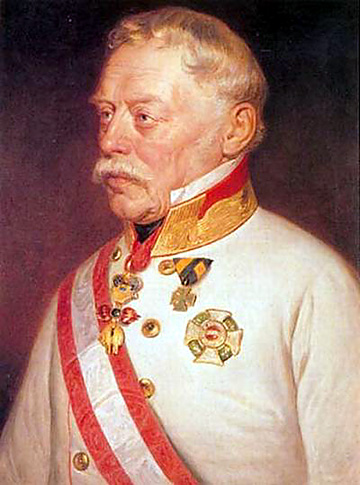
Radetzky, maybe responsible for Schnitzel.
Perhaps, as a young English-speaking child, you snickered at the name "Wiener Schnitzel." I probably did too, but now I've come to appreciate this dish. What is Schnitzel? The story goes that Schnitzel, as a concept, was introduced to Austria sometime between 1500 and 1900 by someone. (Awful vague, right? It's hard to answer questions like this, honestly.) Most likely, it came from Italy, where you find veal and chicken scaloppini served on a regular basis—these are cutlets of the meat, pounded thin to cook quickly. Schnitzel bears a strong resemblance to the preparation for the classic Chicken (or Veal) Parmesan dish, where a piece of meat is breaded and cooked under marinara, mozzarella, and Parmesan cheese. I like (mostly because I love the music named after him) the theory that credits Marshal Radetzky with bringing the dish to Vienna in 1857 or so, upon his return from fighting in Italy. Other theories include Italian or German soldiers bringing it over to Austria during the 17th century. Regardless, it's become a classic dish in Austria and the world over, to the point that Austria protects the identity of Wiener Schnitzel by legislation. Now that's dedication.

Veal has typically been a somewhat expensive meat, and one with equal amounts of cachet and controversy. I won't touch on that here, because that's not my purview; the point is, however, that nowadays it's common to find schnitzel made from pork and chicken alongside the traditional veal. For many Jews in Europe during the Victorian era, veal was an unattainable luxury, something eaten very rarely, and so chicken schnitzel became a popular replacement. My grandmother, a Viennese woman, made chicken schnitzel often when I was a child.

Schnitzel is a dish that begs for a sauce. Traditionally, it is served with nothing more than a wedge of lemon (and this is how my mother eats it to this day,) but I crave more moisture and flavor on my plate. For this presentation, I will use a German sauce called Zigeunersauce, which is a sauce made with bell peppers, mushrooms, paprika, and tomatoes. (Thanks to a commenter for prompting me to add this:) Zigeuner is a German word referring to the Romani. I'm not certain if this sauce originated with the Romani people, if it is merely named after them for its colorful look, or if it is so called as a nod to its Eastern European origins (where the Romani clearly came from, or settled, or belonged—depending on who you asked in the Victorian era.) I'm going to make my version of Zigeunersauce a little more refined than the traditional version, with smaller cut items, but otherwise will stick to the recipes that I've found.
The finished plate—braised red cabbage, Chicken Schnitzel, and Zigeunersauce

(Please, to any of my German readers, if you have a different recipe than me, feel free to post it in the comments. Hopefully what I've found approximates what you know. I wish I'd been able to get the recipes from my grandmother when she was still alive.)

Thursday, December 16, 2010

Earl Grey Panna Cotta

Tea, and especially Earl Grey, has become inextricably linked with steampunk. Professor Elemental serenaded it in "Cup of Brown Joy," and many Steampunks enjoy sitting back with a hot pot of tannic liquid. Panna Cotta is an older dessert that's come back of late as American tastes stray towards the gourmet. A combination of the two seems perfectly logical—creamy, delightful, and full of bergamot flavor.

Typically, panna cotta uses milk, cream, and sugar, which is then combined with gelatin. The flavoring is often simply that of the milk products, but additional flavorings are possible; I have made a blood orange panna cotta using blood orange purée, and I have eaten raspberry- and strawberry-flavored versions as well.

Here we are going to apply the tea to the dessert via a direct addition; another way could be to use a method described by my good friends at TeaHaus.