Drop by the Steampunk Cookery website.
Showing posts with label chicken. Show all posts

Friday, June 8, 2012

The Picnic Luncheon: Meats!

Roast Beef. Chicken Pie. On a field expedient Cutting Board.
(Thanks to the reenactors for loaning me a crate.)
This post was written during the progress of making these dishes, and so the tenses and times of the various recipes and commentary may reflect a sort of wibbly-wobbly, timey-wimey approach. Please excuse that, and do not let it hamper your appreciation.
 
For the Victorian Day Picnic Luncheon I am making two meat items, chicken pie and roast beef. I've spent most of the afternoon shopping and preparing these two items, mostly the chicken pie.

I've been somewhat closely following a recipe from Buckeye Cookery for the chicken pie:
Cut up two young chickens, place in hot water enough to cover, boil until tender; line a four or five quart pan with a rich baking-powder or soda-biscuit dough quarter of an inch thick, put in part of chicken, season with salt, pepper and butter, lay in a few thin strips or squares of dough, add the rest of chicken and season as before; some add five or six fresh eggs or a few new potatoes in their season; season liquor in which the chickens were boiled with butter, salt, and pepper, add a part of it to the pie, cover with crust a quarter of an inch thick, with a hole in the center the size of a tea-cup. Keep adding the chicken-liquor and hot water if needed, since the fault of most chicken pies is that they are too dry. There can scarcely be too much gravy. Bake one hour in a moderate oven, having the heat turned to the bottom, as great care is necessary to have the bottom crust well baked.

Tuesday, February 7, 2012

Polastrello in Padella

There's a truth about being a chef. It's a sad truth, but a truth nonetheless: The minute you get through culinary school, you stop relying so heavily on recipes; this is also the time that you will be given the most cook books.

Nowadays, I tend to use my modern-era cookbooks as a source of inspiration, rather than a direct recipe source. I can flip through a cookbook full of soups, spot an idea that I like, and adapt it to suit my needs, tastes, or supplies on hand. Tomato soup becomes roasted tomato soup becomes tomato-basil bisque becomes tomato, chicken, and rice soup. It's easy to rewrite a recipe if you know what you're doing, and it's easy to write a recipe from scratch.

Yet, there are some books that I will cook from verbatim, whose recipes I will memorize and cook over and over again, because they are so good. La Tavola Italiana, by Tom Maresca and Diane Darrow, is one such book, and their recipe for Polastrello in Padella (Braised Chicken) is simply divine. It's simple, flavorful, and delicious.

Earlier this year, we purchased several chickens from Melo Farms. They were large chickens (between 4 and 5 pounds) and were definitely older—their bones were bigger, and their joints harder to butcher when I was working with them. We roasted one plain, and determined that the meat was just a bit too tough to work well with fast, hot cooking. Moist heat, as I've mentioned before, works well for tough meats, helping to break down the muscle tissues without losing the moisture that makes it palatable.

Polastrello in Padella is a recipe that works equally well with your average supermarket chicken and an old bird like we had.

Thursday, December 8, 2011

Chicken Curry - From Leftovers

Photograph by Mark Staubitz, at Teslacon II
(The blue pot soon to hold chicken curry.)
Mrs. Beeton and many of her contemporary cookbook writers were very concerned with using leftover food. In an age lacking refrigeration or the ability to freeze leftover food, the remedy was to create recipes to use that cooked meat, like Chicken Croquettes, meat pies, and stews of cooked meat. These recipes highlight one of the main drives of cooking in the Victorian era, a desire—and indeed a need—for food utilization. Sausages, terrines, and pâtés all see their beginnings in this need to utilize all the parts of a meat animal, and recipes like the one below (and a hundred different variations on hashed meat) come from a need to make something of the very valuable food items left after a meal.

Friday, June 10, 2011

Chicken Curry

Photos by Russ Turner Photography
In The Curry Cook's Assistant, from 1889, the following recipe is given:
No. 8.—CHICKEN CURRY.
One good-sized Chicken (about a pound or more).

Other ingredients same as for Madras Curry, No. 4. Now cut up the chicken in half of each joint. Keep it to a side. Now fry the onions, sliced, in a stew-pan, with a large spoon of butter. When the onions are nice and brown, just fry the chicken in it less than half done. Take it out and keep to a side. Now fry the Curry Powder till it is nice and dark brown, then add the chicken, more onions, and other things into the frying Curry Powder, etc., and add half-pint of good gravy, and set it on a slow fire for 20 minutes. When serving, add two large spoons of cream. If it is very dry, add little more gravy to it. A few drops of lemon will flavour it, but I recommend to make the chicken into a “moley,” as No. 29. Much nicer to be eaten with rice or treated as an ordinary entree, and the curried fowl (whole) nicer as a joint.
Madras Curry (No. 4) reads as follows:
No. 4.—BEEF CURRY (Madras).

For a Pound of Beef.
2 Tablespoons Coriander Powder and 1 of Rice Powder.
1 Saltspoon Saffron and a Pinch of Cumin Powder and Fenugreek.
½ Pint of Milk or good Gravy.
1 Large or few small Onions.
A bit of Cinnamon, 2 Cloves (if you wish spices).
½ Teaspoon Green Ginger chopped up fine.
A Small Garlic chopped up fine.
1 Large Spoonful of Butter (fresh); Salt to taste.

N.B.—This Curry is made in Madras with or without Cocoanut, but little Tamarind will flavour this Curry better than Lemon Juice. Vinegar, Curry Leaves, etc., are used in Madras and Ceylon. This is a first-class Curry if carefully prepared.

Mode.—Have the meat ready cut in half-inch squares; then slice the onions; put a good stew-pan on the fire, add the butter; soon as the butter gets hot put in the onions and Curry Powder, but not the ginger, garlic, and spices. When the onions, Curry stuffs, etc., are nicely browned, add the meat, garlic, ginger, spices, and give it a turn. Let it stand for a few seconds, then add the milk or gravy, salt, etc.; set on slow fire for about 20 minutes. When sending to table add a few drops of lemon or good pickle vinegar, but tamarind is best. Add little cayenne if preferred hot; a hot Curry is considered always nice and healthy, the cayenne to be added when preparing.
Now, being as I am a modern-day chef, I don't necessarily put each spice into the dish on its own in turn; I like curry powder, and I'm happy to use it.

Wednesday, May 18, 2011

Maghreb Braised Chicken Thighs

Thighs! The mere word sends shivers up the spine. Chicken thighs, however, are a little less titillating, and a little more hunger-stimulating.

This recipe developed as a way to use the thighs from the chicken I broke down during my practice for my Practical Exam earlier this year. When you create the finished plate for that exam, you're expected to use the chicken breasts, and are not required to use any other part of the bird for any reason. I suppose you could, but there's no real requirement.

Anyhow, having had the recent experience of the Classical Restaurant class, and thinking of ways to put more than one protein item on a plate, I came up with this as a little side dish for the home version of my plate—something I'd do here, and not replicate at school unless I had a whole boatload of free time. From there, however, it spiraled into something my mother liked, and that I ended up serving at a local underground restaurant event.

Wednesday, January 26, 2011

Chicken Consommé

Clear soup. Not just clear, but crystalline. It is—or can be—perfection in a bowl. The effort put into creating such a dish speaks through the gentle flavors, perfect clarity, and precisely prepared garnishes. It is a foundation of the classic cuisine of Escoffier, but it originated earlier.

What Mrs. Beeton described in her entry "To Clarify Stock" was refined over the ensuing 40 years into Escoffier's King of Soups—Consommé. The concept of a clarified stock has been around for many years—indeed, some recipes can be found dating to the medieval period—but it has been refined over the ensuing years.

Mrs. Beeton said,
INGREDIENTS - The whites of 2 eggs, 1/2 pint of water, 2 quarts of stock.
Mode.—Supposing that by some accident the soup is not quite clear, and that its quantity is 2 quarts, take the whites of 2 eggs, carefully separated from their yolks, whisk them well together with the water, and add gradually the 2 quarts of boiling stock, still whisking. Place the soup on the fire, and when boiling and well skimmed, whisk the eggs with it till nearly boiling again; then draw it from the fire, and let it settle, until the whites of the eggs become separated. Pass through a fine cloth, and the soup should be clear.
This technique has only changed slightly since her writing—the basis of clarification is still egg whites, but now we include lean ground meat and mirepoix in the process, creating a mixture known as "clearmeat," which is then simmered in the stock, to create what is known as a "raft;" this raft traps the impurities in the stock and enriches it simultaneously, creating wonderful flavors.

Monday, January 17, 2011

Mulligatawny Soup

Mulligatawny soup was one of the first things I made at home after I started cooking school. It's an inherently simple recipe if you don't strive to make it difficult, and it's very Victorian in origin. The British had colonies in India (as we all know) and the quite fashionable chaps who subjugated and exploited the native people of that country liked to "go native," or adopt a few customs here and there from their innocent victims. One of the popular items to make its way back to England (along with curry in general) was this soup, the name of which means "Pepper Water" in Tamil.

Almost every period cook book in my collection—encompassing both physical and electronic—contains a recipe for Mulligatawny Soup. Herein is presented a quick sampling of them, and then a recipe combining elements of each.

Wednesday, December 22, 2010

Chicken Schnitzel with Zigeuner Sauce

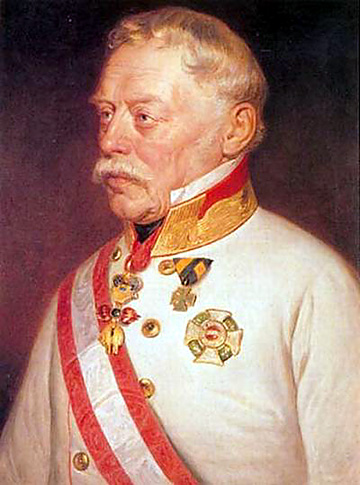
Radetzky, maybe responsible for Schnitzel.
Perhaps, as a young English-speaking child, you snickered at the name "Wiener Schnitzel." I probably did too, but now I've come to appreciate this dish. What is Schnitzel? The story goes that Schnitzel, as a concept, was introduced to Austria sometime between 1500 and 1900 by someone. (Awful vague, right? It's hard to answer questions like this, honestly.) Most likely, it came from Italy, where you find veal and chicken scaloppini served on a regular basis—these are cutlets of the meat, pounded thin to cook quickly. Schnitzel bears a strong resemblance to the preparation for the classic Chicken (or Veal) Parmesan dish, where a piece of meat is breaded and cooked under marinara, mozzarella, and Parmesan cheese. I like (mostly because I love the music named after him) the theory that credits Marshal Radetzky with bringing the dish to Vienna in 1857 or so, upon his return from fighting in Italy. Other theories include Italian or German soldiers bringing it over to Austria during the 17th century. Regardless, it's become a classic dish in Austria and the world over, to the point that Austria protects the identity of Wiener Schnitzel by legislation. Now that's dedication.

Veal has typically been a somewhat expensive meat, and one with equal amounts of cachet and controversy. I won't touch on that here, because that's not my purview; the point is, however, that nowadays it's common to find schnitzel made from pork and chicken alongside the traditional veal. For many Jews in Europe during the Victorian era, veal was an unattainable luxury, something eaten very rarely, and so chicken schnitzel became a popular replacement. My grandmother, a Viennese woman, made chicken schnitzel often when I was a child.

Schnitzel is a dish that begs for a sauce. Traditionally, it is served with nothing more than a wedge of lemon (and this is how my mother eats it to this day,) but I crave more moisture and flavor on my plate. For this presentation, I will use a German sauce called Zigeunersauce, which is a sauce made with bell peppers, mushrooms, paprika, and tomatoes. (Thanks to a commenter for prompting me to add this:) Zigeuner is a German word referring to the Romani. I'm not certain if this sauce originated with the Romani people, if it is merely named after them for its colorful look, or if it is so called as a nod to its Eastern European origins (where the Romani clearly came from, or settled, or belonged—depending on who you asked in the Victorian era.) I'm going to make my version of Zigeunersauce a little more refined than the traditional version, with smaller cut items, but otherwise will stick to the recipes that I've found.
The finished plate—braised red cabbage, Chicken Schnitzel, and Zigeunersauce

(Please, to any of my German readers, if you have a different recipe than me, feel free to post it in the comments. Hopefully what I've found approximates what you know. I wish I'd been able to get the recipes from my grandmother when she was still alive.)