Drop by the Steampunk Cookery website.
Showing posts with label adaptation. Show all posts

Monday, December 5, 2011

Wintertime Trifle

One of the most quintessentially British of desserts, Trifles have allegedly existed since the end of the 16th century. In the Complete Traditional Recipe Book, Sarah Edington says,
Trifle is one of those dishes for which no one can agree on the correct recipe. Grown men remember with affection the trifle made by their mothers and grandmothers and come to blows over whether or not jelly and/or jam should be ingredients.
I won't make any claim to one version of a trifle that's any more correct than any other, but I will present you a short history of the Trifle as I can assemble it from some of the cookbooks in my collection.

Friday, September 16, 2011

A Triumphant Return

Or sort of, anyhow. The restaurant and I have amicably parted ways—I wasn't exactly what they needed, and they weren't exactly what I needed, and that was (as they say) that. They're some very nice businesspeople and I would work for them again in the future, if the opportunity presented itself.

Once again, that leaves me here to contemplate life, the universe, and everything—and to cook delicious food and present it to the lot of you!

Last week, I returned to the Phoenix Café, with two dishes for the assembled masses: From New Vegetarian Dishes by Mrs. Bowdich, 1892, a preparation of Green Beans (which I purchased fresh at that week's Tuesday Market at Eastern Market,) and Chicken Cacciatore.

Green Beans 
1 shallot, minced
1 pint (473 ml) tomato juice
1 pound (453 g) green beans, steamed and shocked
1/2 teaspoon (2.5 ml) salt
1/4 teaspoon (1.25 ml) pepper
a blonde roux of 1 oz (28 g) flour and 1 oz (28 g) olive oil
 

1. Sweat the shallot, and add the tomato juice. Whisk in the roux, Bring to a boil, reduce the heat and simmer about half an hour.

2. Season with pepper and salt. Add the Green beans in, and thoroughly re-heat.

(When I prepared this, I used tomato purée instead of juice, and a bit of garlic instead of a shallot. I think the results were comparable. This is a very simple dish, and I like it that way—even though my compulsion is to complicate it overmuch.)

On to the second recipe: Chicken Cacciatore. It's a recipe that has existed more or less in the same manner for many years; I have a cookbook from the turn of the 20th century called "The Cook's Decameron" that includes a recipe for Cacciatore; indeed, "Hunter-Style" food is a common item in many cuisines, usually containing more "rustic" (or wildly available) items like mushrooms, as well as "spicier" things like bell peppers. (French cuisine includes "Forestière" sauce, for example.) I've figured out a way to make the recipe cook more quickly, so that I can serve it in under an hour from start to finish.


Chicken Cacciatore
2 pounds (907 g) chicken meat (I used breasts,) boneless, skinless, and cut into 1" (2.5 cm) cubes
2 Orange Bell Peppers, Julienne
2 Green Bell Peppers, Julienned
2 White Onion, Julienne
1 pound (455 g) White Button Mushrooms, Sliced
2 28-oz (794 g) cans Diced Tomatoes
Dry Red Wine
Salt and Pepper 
Oregano
Olive Oil

1. Salt and pepper the chicken, and sear it in hot oil. Set aside.

2. Heat more oil and begin to cook the onions. When they have become somewhat translucent, add the bell peppers. Cook until slightly softened.

3. Add the chicken back in, and the mushrooms. Cook until the mushrooms are softened.

4. Add a good quantity of red wine (it will depend on how large your cooking vessel is how much you want to use,) and cook until mostly evaporated. Add the tomatoes and season with salt, pepper, and a good amount of oregano. Simmer until the chicken is cooked through.

I apologize I don't have any pictures of either of these dishes at this time—hopefully I'll add some soon.

Friday, June 24, 2011

Potato Soup

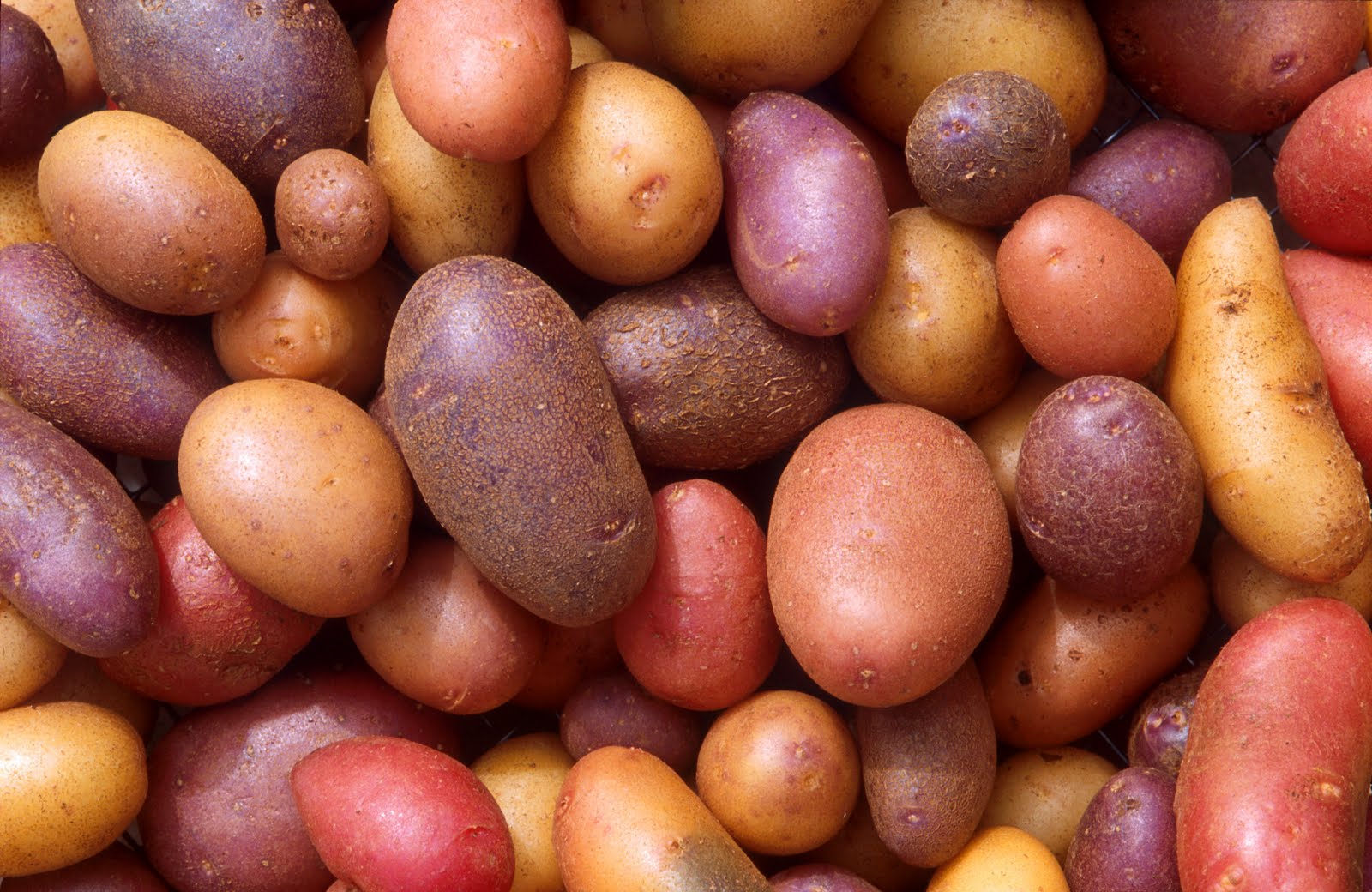
Potatoes—delicious in many ways.
The lovely and talented Miss Hayley Jane (also available at Facebook and more) is, I have learned, a fan of potatoes. Being as I have some Irish heritage, the potato is a familiar item to me as more than just a thing to mash, boil, or bake. As much as I do enjoy taking potatoes, chopping them up, boiling them up, and/or putting them in stews, I also enjoy playing with potatoes in many different manners, such as using them to thicken sauces, making them into chips (Saratoga Potatoes, which are covered well by the Culinary Chronoaviatrix,) roasting them for salads, and generally trying new and different ways to use the humble potato.

Today, I am making potato soup. Simple, clean, and delicious. There's half a million recipes for potato soups; each cookbook I have in my collection has at least one, and some have more than that. As is my style, I shall present to you a few recipes, followed by the one that I will use for tonight's little dish—an item being sold at the bookstore for Craft Night.

Potage Printanier—French Springtime Soup

Much like Chicken Soup, there are myriad variations on the Potage Printanier; Technically speaking, the name merely means "Springtime Soup" and therefore can be made with any number of springtime vegetables, generally resulting in a green, semi-thick soup. Typically it includes peas as a main ingredient. Some recipes will have it merely be a puréed pea soup; others include lettuce and greens; others include asparagus and haricots, and many include egg. It's all a matter of whose cook book you use.

Wednesday, June 22, 2011

Tomato-Basil Bisque

Bisques are traditionally a French soup made from crustacean shells. They are smooth, creamy, and highly seasoned. Typically, you lightly cook the shells to develop a rosy color, then simmer them with wine and other aromatic spices; they are strained out, ground, and the soup is thickened with a combination of the ground crustacean shells and roux or rice, leaving a smooth, creamy, and delightful dish.

Being as I am allergic to crustaceans, Lobster Bisque and Shrimp Bisque (and Crawfish Bisque and...) don't hold much interest to me, and therefore for the soup feast I set upon a very bright and flavorful soup, one of my personal favorites, Tomato-Basil Bisque.

Friday, June 10, 2011

Chicken Curry

Photos by Russ Turner Photography
In The Curry Cook's Assistant, from 1889, the following recipe is given:
No. 8.—CHICKEN CURRY.
One good-sized Chicken (about a pound or more).

Other ingredients same as for Madras Curry, No. 4. Now cut up the chicken in half of each joint. Keep it to a side. Now fry the onions, sliced, in a stew-pan, with a large spoon of butter. When the onions are nice and brown, just fry the chicken in it less than half done. Take it out and keep to a side. Now fry the Curry Powder till it is nice and dark brown, then add the chicken, more onions, and other things into the frying Curry Powder, etc., and add half-pint of good gravy, and set it on a slow fire for 20 minutes. When serving, add two large spoons of cream. If it is very dry, add little more gravy to it. A few drops of lemon will flavour it, but I recommend to make the chicken into a “moley,” as No. 29. Much nicer to be eaten with rice or treated as an ordinary entree, and the curried fowl (whole) nicer as a joint.
Madras Curry (No. 4) reads as follows:
No. 4.—BEEF CURRY (Madras).

For a Pound of Beef.
2 Tablespoons Coriander Powder and 1 of Rice Powder.
1 Saltspoon Saffron and a Pinch of Cumin Powder and Fenugreek.
½ Pint of Milk or good Gravy.
1 Large or few small Onions.
A bit of Cinnamon, 2 Cloves (if you wish spices).
½ Teaspoon Green Ginger chopped up fine.
A Small Garlic chopped up fine.
1 Large Spoonful of Butter (fresh); Salt to taste.

N.B.—This Curry is made in Madras with or without Cocoanut, but little Tamarind will flavour this Curry better than Lemon Juice. Vinegar, Curry Leaves, etc., are used in Madras and Ceylon. This is a first-class Curry if carefully prepared.

Mode.—Have the meat ready cut in half-inch squares; then slice the onions; put a good stew-pan on the fire, add the butter; soon as the butter gets hot put in the onions and Curry Powder, but not the ginger, garlic, and spices. When the onions, Curry stuffs, etc., are nicely browned, add the meat, garlic, ginger, spices, and give it a turn. Let it stand for a few seconds, then add the milk or gravy, salt, etc.; set on slow fire for about 20 minutes. When sending to table add a few drops of lemon or good pickle vinegar, but tamarind is best. Add little cayenne if preferred hot; a hot Curry is considered always nice and healthy, the cayenne to be added when preparing.
Now, being as I am a modern-day chef, I don't necessarily put each spice into the dish on its own in turn; I like curry powder, and I'm happy to use it.

Wednesday, June 8, 2011

Seared Asparagus

Photgraph by Russ Turner Photography
In The Italian Cook Book from 1919, the following entry appears for asparagus:
Asparagus can be prepared in many different ways, but the simplest and best is that of boiling them and serving them seasoned with olive oil and vinegar or lemon juice. However there are other ways as, for instance, the following: Put them whole to brown a little with the green part in butter and, after seasoning them with salt, pepper and a pinch of grated cheese, pour over the melted butter when it is browned. Or else divide the white from the green part and place them as follows in a fireproof plate: Dust the bottom with grated cheese and dispose over the points of the asparagus one near the other; season with salt, pepper, grated cheese and little pieces of butter. Make another layer of asparagus and, seasoning in the same way, continue until you have them. Be moderate in the seasoning. Cross the layers of asparagus like a trestle, put on the oven and keep until the seasoning, is melted. Serve hot.

If you have some brown stock, parboil them first and complete the cooking with brown stock, adding a little bust and dusting moderately with grated cheese.
In every other cook book, from Mrs. Beeton to Buckeye Cookery, asparagus is suggested to be served boiled and laid on toast—so I combined the two ideas, and served seared asparagus (similar enough to broiling for my purposes) with lemon and olive oil on a toast point... and then added a little grated cheese.

Friday, May 13, 2011

On Mustard for Picnicking (part Two of Two)

Welcome back, true believers! Today, I shall finish up my discussion of the foods served at the picnic for Grand Ledge Victorian Day.
This was our crew, a fine and gallant bunch. To accompany our luncheon dish of cold roasted chicken, I created a thyme-infused Dijon-style mustard. The recipe came out of a fusion of new and old recipes, as well as basic flavoring techniques.

The mustard was a smash hit at the picnic, winning commendations from the picnickers and visiting soldiers alike (our blankets are a neutral zone where Union and Rebel may eat together in peace and harmony. And booze.)

As is my habit, however, I shall herein discuss a little bit about the creation of mustard over the Steampunk era, and present a few recipes from my collection of cook books.

Wednesday, May 11, 2011

A Picnic! (Part One of Two)

Roast Capon
This past Saturday saw the much-needed trip to an event in my area, Grand Ledge Victorian Day. It is an incredibly enjoyable event, featuring croquet, Civil War reenactments, a low tea, quilts, antiques, a parade, a beard and mustache contest, and educational programming about the Victorian era. In particular, my friends and I (a motley group including Miss Kagashi of The Steamer's Trunk and our various associates, some from the Imperial Anti-Piracy Squadron) have established a tradition (which I have taken to calling "The First Manassas/First Bull Run Memorial Picnic" in homage to that battle) of picnicking during the Civil War skirmish. This year, Miss Kagashi and I coordinated ourselves to prepare some picnic items from the book Buckeye Cookery and Practical Housekeeping, which says:
The following bills of fare may be picked to pieces and recombined to suit tastes and occasions:

SPRING PICNICS.--Cold roast chicken; ham broiled on coals; fish fried or broiled; sardines; tongue; hard-boiled eggs; eggs to be fried or scrambled; Boston corn bread; buttered rolls; ham sandwiches prepared with grated ham; orange marmalade; canned peaches; watermelon and beet sweet-pickles; euchered plums; variety or bottled pickles; chow-chow; quince or plum jelly; raspberry or other jams; Scotch fruit, rolled jelly, chocolate, Minnehaha, old-fashioned loaf, and marble cake; coffee, chocolate, tea; cream and sugar; salt and pepper; oranges.
We set upon having a somewhat simpler picnic, not using everything off that list, and designed the following list of provisions, which we believed would suffice:

Monday, May 9, 2011

Lamb Curry

This is what we call "Kitchen Face"
Here in my collection, I have a book called "The Curry Cook's Assistant," published in 1887. It's a little dense, and the recipes not always the clearest; yet, they are useful in that they showcase the sheer variety of curry dishes. (Of note, it's available through Project Gutenberg—which is an utterly invaluable resource—right here. They have a whole passel of cook books on there, and I may well exhaust my digital storage space saving them.)

The Phoenix Café, which I have discussed before, celebrated our DJ's birthday this month. I spoke with him last month and asked him what he'd like, food-wise, at his second 22nd birthday party. He requested that I create a lamb dish in his honor, and I suggested a lamb curry. My suggestion was met with enthusiastic nodding and excited eye movements, so I went with it.

I found a gorgeous leg of lamb on sale at my local farmer's market in one of the many meat purveyors' warehouses, grabbed some onions and old-fashion curry powder, and set them aside for the evening. I had other obligations in the morning, and would have to fetch and cook on the fly. I remained undaunted, and met with resounding success—one of my best-received dishes to date.

Ever the humble servant, I present to you Tommy's Lamb Curry.

Monday, April 11, 2011

Brian Bóru's Delight

The dessert I call "Brian Bóru's Delight" is a simple one, especially compared to the Victorian Tea Trifecta. It is a combination of two simple, old-fashioned desserts: a bread pudding, and a fool.

What is a fool, you ask? It doesn't sound familiar to most modern diners—in fact, my pastry instructor in culinary school didn't immediately know how to explain the Fool to my class. A fool, simply put, is a fruit-flavored whipped cream. It's sort of a precursor to the modern churned ice cream, as it is light, airy, and sweet, but not frozen (as churn-freezing ice cream is a relatively recent development.) Heavy cream is whipped to stiff peaks, and then a purée of fruit, often sweetened, is added in by folding gently. In this recipe, I replaced the purée with fruit preserves, because it's hard to find blackcurrant purée (or indeed, much of anything from blackcurrants) here in Michigan.

Bread pudding is a more familiar item, and in this case I've used a simple white bread, good quality butter, and raisins with a little twist suggested by my friend Brian over at The Boychik Balabusta (a blog you ought to read)—soaking the raisins in Irish Breakfast Tea and whiskey.

Wednesday, March 30, 2011

The Kilkenny Salad

There are two courses, or plates I suppose, that benefit from having names as opposed to being called by their components: salads and desserts. Think of some well-known salads: A Greek Salad, a Caesar Salad, a Cobb Salad, a Waldorf Salad; none of these are named by their components, but rather by an eponymous title of some type, denoting a general style for the salad (it contains Greek ingredients,) it was created by or for a particular person (Caesar and Cobb,) or at a particular place (the Waldorf hotel.) My tendency when naming salads is to go with a thematic name, rather than something directly related to the origin of the salad or its components.

This plate, for the most part, takes its ingredients straight from Irish cuisine: There's potato cakes, made like biscuits; there's a pear, poached in a syrup made from Harp Lager, sugar, and lemon zest and juice; A quenelle of goat cheese, seasoned and mixed with chopped parsley; and a vinaigrette made with lemon juice and salad oil, lightly seasoned with salt and pepper. The salad itself is made with arugula, spinach, and an assortment of baby lettuces, a very springy, slightly spicy mix of greens.

Wednesday, March 16, 2011

Polenta and Polonaise

Polenta is becoming more familiar to mainstream American eaters; many years ago, I first encountered it in this sort of log-shaped container, like Jimmy Dean's loose sausage or a one-pound bullet of ground beef. The polenta was this sort of gelatinous, textured mass that wasn't particularly good. My mother and father didn't really know what to do with it, whether to fry it or grill it or bake it... so my first memory of polenta is of a gritty corn burger. Not the most appetizing thing.

It was many years until I returned to eating polenta, and that at the hands of my culinary school instructors, who showed me the proper method to create smooth, dense porridge that we solidified in the cooler, cut, breaded, and deep fried; then, I was taught how to make it creamy, a mashed-potato substitute that makes a delightful base for braised meat.

Friday, March 11, 2011

The Practical Housekeeper's Salad

While my presentation of this dish may not quite resemble what the authors of The Practical Housekeeper (written in 1857) had in mind, the ingredients and method of preparation are more or less the same.

The book says:
Coss-lettuce and blanched endive make the best salad, the green leaves being stripped off, and leaving nothing but the close, white hearts, which, after being washed and placed for an hour or two in cold water, should be wiped quite dry. To this should be added a head or two of celery, a couple of anchovies (which are far preferable to the essence), and several chives, or young onions, all cut small, while the lettuces should be divided lengthwise into quarters, and cut into rather large pieces.
Generally speaking, blanching endive isn't done much these days, since it's now commonly used as a liner item, the base of a salad plate, and not necessarily a primary component of the salad itself.

Monday, March 7, 2011

Lamb Purses with Garlic Sauce and Zchug

Sometimes, recipes are complex and only applicable to themselves. Other times, a recipe uses some basic techniques which can be applied and re-worked into many different recipes.

This recipe is one from the latter category. It combines a simple pastry dough with a savory ground lamb filling, a combination which can be re-worked time and time again. The original version of this dish is based on a recipe from the Elizabethan era in England, and can be found in various styles throughout the ages. It's similar to a meat pie, and indeed I am using a pie dough recipe for the pastry in this version.

The filling is seasoned in a middle-eastern style, with parsley, rosemary, hot paprika, sumac, salt, and pepper. It's chilled and the flavors are allowed to mingle overnight. Small portions are then wrapped in the pastry, egg washed, then baked until brown, delicious, and cooked through.

I served these delightful little pastries with a thick Garlic Sauce and the eternally popular Zchug.

Friday, January 28, 2011

Roast Pork Loin with Sage-Onion Stuffing and Apple Sauce

Mrs. Beeton prescribes this combination of dishes in her book, and as I am from time to time inclined to take a cook-book writer at their word, I have elected to prepare the dishes exactly as she sets forth.

Exactly, that is, with the exception of any tweaks I might need to make to render the dishes delicious, edible, and suitable for the palates (and diets) of my friends. Mrs. Beeton leaves quite a bit un-said, you see, about the proper manners of cooking; there is much that must be read between the lines of her work, that must be assumed or implied or otherwise added to the simple recipes she provides.

A nice dinner is never amiss, however, and since I'm at home I might as well prepare something that everyone will enjoy—and that will serve as an opportunity to perfect these historical recipes for later use. After all, while half of cooking is creativity, the other half is replication. A dish is no good if I can't make it again the same way.

Wednesday, January 26, 2011

Chicken Consommé

Clear soup. Not just clear, but crystalline. It is—or can be—perfection in a bowl. The effort put into creating such a dish speaks through the gentle flavors, perfect clarity, and precisely prepared garnishes. It is a foundation of the classic cuisine of Escoffier, but it originated earlier.

What Mrs. Beeton described in her entry "To Clarify Stock" was refined over the ensuing 40 years into Escoffier's King of Soups—Consommé. The concept of a clarified stock has been around for many years—indeed, some recipes can be found dating to the medieval period—but it has been refined over the ensuing years.

Mrs. Beeton said,
INGREDIENTS - The whites of 2 eggs, 1/2 pint of water, 2 quarts of stock.
Mode.—Supposing that by some accident the soup is not quite clear, and that its quantity is 2 quarts, take the whites of 2 eggs, carefully separated from their yolks, whisk them well together with the water, and add gradually the 2 quarts of boiling stock, still whisking. Place the soup on the fire, and when boiling and well skimmed, whisk the eggs with it till nearly boiling again; then draw it from the fire, and let it settle, until the whites of the eggs become separated. Pass through a fine cloth, and the soup should be clear.
This technique has only changed slightly since her writing—the basis of clarification is still egg whites, but now we include lean ground meat and mirepoix in the process, creating a mixture known as "clearmeat," which is then simmered in the stock, to create what is known as a "raft;" this raft traps the impurities in the stock and enriches it simultaneously, creating wonderful flavors.

Monday, January 17, 2011

Mulligatawny Soup

Mulligatawny soup was one of the first things I made at home after I started cooking school. It's an inherently simple recipe if you don't strive to make it difficult, and it's very Victorian in origin. The British had colonies in India (as we all know) and the quite fashionable chaps who subjugated and exploited the native people of that country liked to "go native," or adopt a few customs here and there from their innocent victims. One of the popular items to make its way back to England (along with curry in general) was this soup, the name of which means "Pepper Water" in Tamil.

Almost every period cook book in my collection—encompassing both physical and electronic—contains a recipe for Mulligatawny Soup. Herein is presented a quick sampling of them, and then a recipe combining elements of each.

Friday, January 14, 2011

Baklava and Turkish Coffee

Baklava in front and to the right, gingerbread to the left.
Our dessert for the State Dinner at the Dolmabahçe was Baklava—layers of phyllo dough surrounding a filling made of chopped nuts and rose water. It's popular in the area formerly controlled by the Ottoman Empire—of course, Turkey being the center of this region—and has a long, rich, and murky history.

Wikipedia says, "The history of baklava is not well-documented. It has been claimed by many ethnic groups, but there is strong evidence that it is of Central Asian Turkic origin, with its current form being developed in the imperial kitchens of the Topkapı Palace." (The Topkapı Palace was the palace used by sultans until the construction of the Dolmabahçe.) Beyond this certainty, there are many theories about the origins of Baklava, crediting it to a vast number of places ranging from ancient Mesopotamia to Greece to China—few of these can be properly substantiated, and indeed Baklava as we know it came about sometime between 150 and 450 years ago.

Oz and Blue (right) with Phyllo.
The cook for the dessert course was not, in fact, our good friend Oz. It was our other good friend Blue, who puts together desserts as though it were part of her nature to do so. She is also one of the most stalwart of kitchen helpers, usually eschewing dinner to help plate food and wash dishes. It's a pleasure to let her take over the kitchen, and a pleasure to work with her.

She made two versions of Baklava, and has provided me with both of the recipes, which I shall now pass on to you. I have preserved the two recipes separately—though they are very similar—as they were provided to me. The procedure is somewhat tedious, but the results are well worth the effort.

At the dinner, we served the baklava with a cup of Turkish Coffee. The term refers to the method of preparation, and not to a specific blend or style of bean; it is the foundation of a strong coffee-house culture in Turkey, and a delightfully different way of enjoying your coffee fix. A link to a good recipe is included at the bottom.

Wednesday, January 12, 2011

Döner Kebab-Döner Kebap

Döner Kebap Porsiyon—A main dish serving
Our guide to Turkey, Oz, says, "The complexities and scale involved in making this dish generally drive the home cook away. I was first exposed to it in a restaurant in Izmit, Turkey, outside of Istanbul. A gyro-like combination of Ground lamb, beef, and sirloin is cooked on a vertical spit and shaved as needed."

Döner Kebap, literally meaning "Rotating Roast," is a common dish found across much of the Middle East, now popular in Europe—sold by street vendors as Döner Kebab and in Middle Eastern restaurants—, and is best known in the United States as Shawarma or Gyros. All of these preparations come from the same origin; to quote Wikipedia:
In his...family Biography, İskender Efendi from...19th century Bursa claims that "he and his grandfather had the idea of roasting the lamb vertically rather than horizontally, and invented for that purpose a vertical mangal". With time, the meat took a different marinade, got leaner, and eventually took its modern shape.
Traditionally, the concoction is usually made from many solid pieces of meat, pounded thin, marinated, and placed in layers on a skewer; often, a mixture of ground trimmings from the meat, spices, and an egg (to act as a binder) is spread between the layers; the stack then is topped with fat, and sometimes an onion or tomato to add more flavor. The skewer is then placed vertically in a rotisserie and cooked until it's done, with portions shaved off as needed with a knife (or sometimes some kind of electric trimmer device.)