|
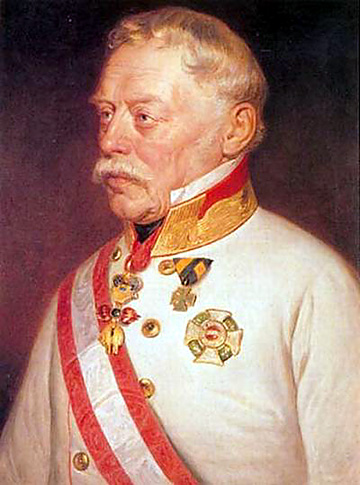
| Radetzky, maybe responsible for Schnitzel. |
Perhaps, as a young English-speaking child, you snickered at the name "Wiener Schnitzel." I probably did too, but now I've come to appreciate this dish. What is Schnitzel? The story goes that Schnitzel, as a concept, was introduced to Austria
sometime between 1500 and 1900 by
someone. (Awful vague, right? It's hard to answer questions like this, honestly.) Most likely, it came from Italy, where you find veal and chicken scaloppini served on a regular basis—these are cutlets of the meat, pounded thin to cook quickly. Schnitzel bears a strong resemblance to the preparation for the classic Chicken (or Veal) Parmesan dish, where a piece of meat is breaded and cooked under marinara, mozzarella, and Parmesan cheese. I like (mostly because I love the
music named after him) the theory that credits Marshal Radetzky with bringing the dish to Vienna in 1857 or so, upon his return from fighting in Italy. Other theories include Italian or German soldiers bringing it over to Austria during the 17th century. Regardless, it's become a classic dish in Austria and the world over, to the point that Austria protects the identity of Wiener Schnitzel by legislation. Now that's dedication.
Veal has typically been a somewhat expensive meat, and one with equal amounts of cachet and controversy. I won't touch on that here, because that's not my purview; the point is, however, that nowadays it's common to find schnitzel made from pork and chicken alongside the traditional veal. For many Jews in Europe during the Victorian era, veal was an unattainable luxury, something eaten very rarely, and so chicken schnitzel became a popular replacement. My grandmother, a Viennese woman, made chicken schnitzel often when I was a child.
Schnitzel is a dish that begs for a sauce. Traditionally, it is served with nothing more than a wedge of lemon (and this is how my mother eats it to this day,) but I crave more moisture and flavor on my plate. For this presentation, I will use a German sauce called
Zigeunersauce, which is a sauce made with bell peppers, mushrooms, paprika, and tomatoes. (Thanks to a commenter for prompting me to add this:) Zigeuner is a German word referring to the Romani. I'm not certain if this sauce originated with the Romani people, if it is merely named after them for its colorful look, or if it is so called as a nod to its Eastern European origins (where the Romani
clearly came from, or settled, or belonged—depending on who you asked in the Victorian era.) I'm going to make my version of Zigeunersauce a little more refined than the traditional version, with smaller cut items, but otherwise will stick to the recipes that I've found.
 |
| The finished plate—braised red cabbage, Chicken Schnitzel, and Zigeunersauce |
(Please, to any of my German readers, if you have a different recipe than me, feel free to post it in the comments. Hopefully what I've found approximates what you know. I wish I'd been able to get the recipes from my grandmother when she was still alive.)